Saturday, November 5, 2016

Sleeping Beauty chateau


The chateau d'Ussé in the small village of Rigny Ussé is said to have been the inspiration for Charles Perrault's fairy tale - La Belle au Bois Dormant - the Sleeping Beauty.  With its many turrets and the forest behind, it's easy to see why.

There has been a chateau on the site since 1000AD, when it was a defensive property. Over the centuries it has been transformed and extended, and it was in the 17th century that it began to take it's current form as a place of residence and it is now owned by the Duke of Blacas and his family.

A visit includes traditionally furnished state rooms, an exhibition of Belle Epoque costumes, stables, the dungeon and of course, scenes from the Sleeping Beauty tale.

In the village there is a café overlooking the chateau and a pleasant riverside walk.


Thursday, November 3, 2016

l'Abbaye de Fontevraud


Fontevraud village is dominated by the abbey buildings - founded in 1101 it is steeped in history. Most of the main buildings have been painstakingly restored and the areas open to the public are full of rich architectural features and centuries of history.

Highlights include the tombs of Richard the Lionheart, and his parents Eleanor of Aquitaine and Henri II, the beautiful cloister square and the unusual kitchen with its many chimneys - from the outside it looks a little like stone pineapples.

In 1792, after the French Revolution, the last abbess was removed from the site and Napoleon Boneparte ordered it opened as a prison in 1804; it had the reputation of one of the toughest in France. During World War II members of the Resistance were imprisoned here and the prison finally closed it's doors in 1963.

Since then the renovations and 'remodelling' of the site mean it is now a fascinating stroll through time with something for everyone; there is an iPad visit for children and art exhibitions and displays in the cellars.


Wednesday, November 2, 2016

The area's rivers


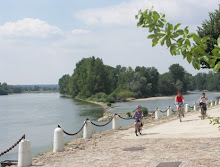
We are in the Loire Valley, so of course, the Loire river is a dominant feature. It's the longest river in France (1012km) rising in the Massif Central and reaching the Atlantic ocean at St Nazaire, near Nantes.  When it passes through our area, it is wide and regal - flowing deepest in late spring, with the snow melt run-off from the upstream mountains - and even when the river levels are low in summer, revealing islands and sand banks, it is still deemed too dangerous for swimming.

There are other rivers to see too, though; the most notable are the Vienne, Indre and Cher - all tributaries of the Loire, and all with their unique charms and character.  The Vienne runs through Chinon; it's gentler-flowing and ideal for the canoe trips you can take from there.  The Indre passes near Chateau Ussé (the 'Sleeping Beauty' chateau) and looks like a moat as it flows round the chateau in Azay-le-Rideau.   The chateau of Chenonceau - the most visited in the Valley - straddles the river Cher; there are great reflection photos to be had if the light is right.


Monday, October 31, 2016

Bourgueil town

Our breaks are based in and around the market town of Bourgueil.  With a population of around 4000 this small town has narrow streets, beautiful stone buildings and plenty of cafés to relax in.  It is also where you'll find the local restaurants and supermarkets.  For such a small town, we are blessed with a great range of places to eat, from an excellent pizza and galette restaurant (save room for a crepe dessert) the wine bar/brasserie where you visit the cellar to choose your own wine, and a couple of high quality gourmet restaurants which won't break the bank. There are also 3 supermarkets if you prefer to cater for yourselves one -or more nights; maybe you'll concoct a 4 course feast, enjoy a barbecue, or grab some local cheese and wine and a crusty baguette and enjoy them in the garden of your accommodation.

Our breaks all include transport to and from Bourgueil for the restaurants and supermarkets, so you can enjoy the full range of what's on offer.  We also include a visit to the weekly market; the whole centre of town is pedestrianised and you can browse around 80 stalls - mostly food, but also clothes, hats, bags, shoes, kitchen tools....Why not pick up provisions for a picnic lunch, then enjoy a coffee at a pavement café and watch the world go by.


Thursday, April 4, 2013

Chateau de Gizuex

One of the closest chateaux to us is in the village of Gizeux.  It doesn't feature heavily in the guide books and is certainly not on the itineraries of the whistle stop tour buses that visit the Loire.  It is, though - in my opinion - well worth a visit, for several reasons.
 
The chateau is owned by Géraud and Stéphanie de Laffon and has been in their family since 1786.  They live there with their 6 children and the on-going restoration of their (very large!) family home is a life-long passion.

Visits to the chateau are guided - often by the owners themselves - and this gives you a fascinating insight not only to the very personal history of the building and its inhabitants, but also what it means to be the owners and - as they call themselves - safe-keepers of this heritage.  If you are lucky enough to join the summer visit at 10.30am, in addition to the usual tour, you will get to visit the private salon and the attics and learn in even more detail what is involved in the upkeep and restoration.

One personal story which sticks in my mind relates to the chateau's cellar.  Here there is an underground tunnel which leads to the presbytery next to the church in the village centre.  During the war, French resistance members were hidden here, despite part of the chateau being used by German soldiers.  A few years ago, Géraud was conducting a visit and whilst in the cellars, an elderly gentleman gave him the first names of 4 people and asked if they still lived there or locally.  Géraud answered 'yes, they are my mother and her brother and sisters, my mother still lives here - do you know her well?'  The gentleman said he didn't know her at all; whilst he was hiding in the cellars during the war (he was a resistance member), he heard those names being called each day at mealtimes, and had remembered them all that time.


The 'jewel in the crown' of the visit is the gallery of chateaux - 400 square metres of art painted directly onto the walls by art students in 1680; you can see the progression of their skill as you move from the first painting to the last.  Currently undergoing skilled restoration, these almost 400 year-old tableaux are truly remarkable.

There is plenty to interest all ages, in English as well as French - as well as the chateau visit, there is a treasure hunt in the gardens, special events in summer for children (bread baking, costumes for the children to wear and coat-of-arms workshops) and even a wine-tasting visit at 11.15.

The chateau is open every day from Easter and we have details of visit times and special workshops.  It is on a pretty cycling circuit (38km) through the forest and you can either take a picnic to enjoy in the chateau grounds or have a simple lunch in the orangerie.

Sunday, March 17, 2013

Schools in France


We often get asked by our guests what education is like in France, and how it is different from where they live.  Now that between them our boys have experienced all levels of French education from ‘petit section’ (first year of nursery school) through to university, I thought I would describe the system of state school here.  This is very much our personal experience and I understand that school hours/systems may be slightly different throughout France, but hopefully this will give you an idea.

Compulsory education in France begins at age 6.  However, all children from age 3 are guaranteed a free nursery school place and so most children start earlier than 6, albeit maybe on a part-time basis.  The 3 years of nursery school are called petit, moyen and grand sections and emphasis is on learning through play.  School hours are from 9.00am to 4.30pm four days a week, with an hour and a half break for lunch (at this age, certainly here in a rural area, most children go home for lunch).  In petit section, Max and his classmates all went to a little dormitory after lunch for a sleep.

Primary school runs for 5 years, to age 11.  The hours are the same and still 4 days a week; here our boys had Wednesdays off.  Starting from 2013 or 2014, this is being changed to 4 1/2 days, to include Wednesday mornings.  Emphasis at primary age is on learning the basics - lots of French grammar and conjugation - plus the introduction of science, history/geography (one subject), art, music, English, computer studies and sport.  At our boys’ school desks are arranged in rows facing the blackboard and work is in the main done individually with little talking (too much and you are moved to a desk by the teacher - we know this from experience...!).  The children are tested  often, at the end of each 'module' and in all subjects (including sport).

Collège (senior school) comes next; 4 years of study with everyone following the same syllabus and subjects.  School hours are now 8.30am to 5.00pm four days a week, plus 8.30 to 12.30 on Wednesdays, all still with a 90 minute lunch break.  At our boys' college there were also lots of lunchtime clubs - Adam was involved in a cinema club which produced a film at the end of the year, and Max's rugby team recently came 2nd in the regional competition.  Constant testing continues through collège, culminating in the Brevet exam - French, Maths, History/Geography, plus an English oral exam and computer skills testing.

After collège, students have a choice – the main options being academic or vocational Baccalaureats, or other vocational qualifications intended to lead to a specific career or work.  We only have experience of the academic Bac – which for Adam (having chosen the science stream) involved studying French, maths, physics/chemistry, biology, history/geography, English, German, sport and , in the final year, philosophy.  Study was for 3 years, school hours 8.00am to 6.00pm four days a week and 8.00am to 1.00pm Wednesdays.  Still the same constant testing and a final exam in all subjects – to pass you have to gain an average over all subjects of at least 10/20.

Whilst the vocational study route often leads to a job (or job hunt these days) at the end - although students can of course opt for further studies – an academic Bac is seen as a stepping stone to further studies only, usually a minimum of 3 years.  Again there is a choice of route – for those students with a clear idea of their future career this is often at a specific ‘school’ (engineering, medical, business, law); otherwise the route is university.  For this latter the entry requirement is a pass at Bac; for the other options there is usually a more selective process which can include Lycée (high school) results, an entrance exam and/or an interview.  Interestingly, for medical school only a Bac pass is needed; halfway through the first year there is an exam process and failure at this means you leave medical school immediately.

Most students at this level choose a school or university close to home and many travel daily to their studies whilst living at home.  On site campus accommodation is rare so students wishing to live away from home usually have a privately rented apartment (studio/bed-sit/cupboard with a bed and toilet!!).

After a 3 year ‘licence’ (degree) students can enter a job at certain prescribed levels; further study (masters or the equivalent) opens opportunities at a higher level (and the chance to progress further).  This prescribed system of linking qualifications so closely with career progression  - as opposed to experience or aptitude - means that many years of study ‘post-Bac’ are common; jobs are usually advertised with qualifications stated as Bac+ a number – representing the number of years study beyond the age of 18 – and Bac+5 or more is pretty common.  So the fact that state university is (for the moment) free tuition-wise is a big bonus for those of us just setting off on this stage of our childrens’ education!

Whether the French system is better, worse or just different from the UK is impossible to quantify; Adam was 8 when we moved here so really we have only experienced the French system.  They do of course have the benefit of being bilingual and, to some extent, of experiencing both cultures.  How much of a benefit that is to them in adult life, only time will tell…but its all part of the adventure.

Sunday, February 10, 2013

Going Underground

This part of the Loire Valley has a rich heritage of troglodyte buildings.  Troglodyte means 'cave dweller' and probably the most well- known reason for the many caves, dwellings and now semi-troglodyte houses here, is that when the chateaux and manor houses were built for the kings and noblemen, the stone was quarried locally.  This left holes (caves) in which the peasants then lived.

But there is an even older history of underground living here and one of the most impressive places to see this is the Chateau de Brezé.  A short distance from Saumur, whilst the visible chateau was built in the 1300's, the earliest record of a 'chateau' here dates back to 1063.  But to see where the noblemen of this time lived, you have to go down...up to 20 metres below the current ground level.


Back in the 'dark days' the land was often invaded and so those with enough money, power and peasants (to do the work!) dug out a fortified underground home for their family.  Adults, children, and even livestock used to live underground at times of peril and leave those less fortunate to the mercy of the marauding hordes.  You can see niches carved into the stone for chicken roosts, holes used to tie up cattle and horses, and great carved out columns for chimneys and air holes.

This underground village was also tremendously well fortified - with portcullis, narrow winding passages (impossible for attackers to carry spears) and false entrances.


In the 14th century the above-ground chateau was fortified and the dry moat constructed.  In places this is 20 metres deep and is the deepest in Europe and really very impressive; you can see how impenterable the chateau was.

Impressive though the moat itself is, there are more surprises hidden in its inner walls.  During your visit you can see grain stores, silkworm caves, stables and a wonderful 2 storey boulangerie - complete with what must have been a very cosy baker's bed right above the bread oven!  The chateau also owns vineyards and you can see the extensive wine caves (and old stone wine presses) before tasting the produce in the (above ground) stable buildings in the grounds.

 
A visit to this unique chateau is included on our Discovery and Wine tours and we are working on a cycle route there too.


Tuesday, January 29, 2013

Bonne Année!

Every January, in common with other towns and villages all over France, the Maire of St Nicolas de Bourgueil and his fellow councillors hold a 'Ceremonie de Voeux' (New Year's wishes) for the village.  The exact format differs from commune to commune, but each includes a word from the Maire reporting on completed projects from the previous year, plans for the current year and ends in wishing everyone in the village health and happiness for themselves and their families.

Our Ceremonie was held last Saturday and about a quarter of the population (350 folk) attended.  After the word from Christel, our Maire, there was the prize giving for the best floral displays in the village in 2012 - 3 of the councillors travel all over the village during the summer and decide the worthy winners in the courtyard, roadside display and wine press categories (well, we are a wine-growing village!). 

In St Nicolas, we also watch a film each year.  A club in the village usually films all the year's events (school fete, annual football competition, new mother and baby ceremony on Mother's Day, etc.) and presents the film at the Voeux.  This year though we were treated to the second part of a special three-film series which has documented the memories of the old folks in the village.  As well as being a fascinating insight into the village's history over the past 80 years or so, this is an important record - St Nicolas was occupied during the second world war and much of the written records were destroyed - the number of villagers left who remember those days is sadly declining ( 3 have passed away since making this year's film) and so their memories are precious.

This year's film theme was traditional trades and schooldays of old.  Villagers' filmed memories were interspersed with contemporary photos and documents as well as a couple of filmed demonstrations - one by an old basket-weaver and the other by a couple of real characters who used to be blacksmiths.  Their description of the need to clean a horse's hooves before re-shoeing them taught the audience the saying 'le marechal ferrant touche le merde avant l'argent' (you'll have to look up the translation yourselves!).

For the schooldays section, the club had taken a group of current village children to a school museum to spend a day in traditional uniform learning about a typical school day and this footage was interspersed with the old folks' memories. This combining of young and old in the film was particularly touching.

As is tradition for almost every civic gathering here, the event ended with the 'pot d'amitie' - on this occasion sparkling wine and a slice of Galette des Rois (twelfth night cake) a puff pastry tart filled with frangipan - whilst villagers mingled to wish each other happy new year, complain about the terrible weather, gossip, chat and generally have a good time.


Bonne Année à Tous et à Toutes!

Monday, January 21, 2013

Pedalling back in time

Each June for several years now, Saumur has hosted an annual bike event, where the roads are closed alongside the river and cyclists can truly enjoy the freedom of the road.  In 2011, a new side event was added to this already wonderful festival - Anjou Vélo Vintage.

Attracting over 1400 participants last year, this event captures the essence of cycling in its 'glory days' - to take part, riders must have a single speed bike dating from no later than 1987 - luckily (as all our bikes are much newer than that and equipped with lots of gears), these are available to hire - and riders are strongly encouraged to enter into the 'retro' spirit by dressing in vintage clothes from between 1900 and 1970 (I'm sure I probably have some 70's clothes still in my wardrobe!).

This year's event takes place on Sunday 23rd June.  Rides start from just 38km and this route takes you along the Loire and through troglodyte caves and villages.  It passes the chateaux of Saumur and Montsoreau as well as the artists village of Turqant.  For participants, there are refreshment points along the way; highlights are at the renowned red wine makers Chateau de Parnay and the sparkling wine house Bouvet Ladubay.  The circular route ends back in the centre of Saumur at the event 'village' where there will be stands showcasing cycling memorabilia, local products and souvenirs of the event.


As a family we have enjoyed the general bike ride for the last few years and each time the spectacle of the Vintage riders has been wonderful - couples, groups and families all dressed up and enjoying the fun of riding traffic-free routes with street-side entertainment, refreshments and fun.

So this year, we are taking part in the Vintage ride proper - we will be hiring bikes, dressing up (Max still needs to be persuaded of this part) and starting the ride at 10.30am in Saumur.  Our guests staying with us at that time will be welcome to join us - and we can arrange transport to the start and finish points for anyone who needs it.  If we have enough interest, we may enter a company team, and each member of the team will get a retro cycling jersey with Loire Valley Breaks printed on it!

There is a small entry fee to pay, but this includes a souvenir drinks bottle, official entry pack etc. and there is a cost to hire the required old bike.  Of course, it is also possible to ride the public festival route instead - free of charge - and we have a route ready for guests who choose this option.

There are lots of great official photos of the event here http://www.flickr.com/photos/anjou-velo-vintage/collections/72157630417856242/

We still have some availability for a stay around 23rd June, so if this event appeals to you, let us know as soon as possible and we'll book you in.

Sunday, March 20, 2011

Fun Comes in Threes


Spring is definitely, well springing, here in the Loire Valley so we have selflessly taken ourselves out and about - revisiting some favourite places and searching out new destinations and places of interest for our guests.


Whether we are on the bikes or in the car, our route often leads us to and through the adjacent villages of Candes St Martin, Montsoreau and Turquant. These 3 villages lie along the riverside around the confluence of the Vienne and Loire rivers and almost directly across the valley from our home in St Nicolas de Bourgueil. Each one has a wealth of interest - architectural, historical, natural and commercial - and they all feature on our cycle, wine and discovery tour routes. In fact there is so much to see and do that, despite being in such close proximity, we have devised two separate cycle routes for 2011, so guests can have time to take a leisurely cycle to and from their destination and also explore all each village has to offer. Below is a taster of what you can discover in each destination.


Let's start with the westernmost village, Candes St Martin. This is designated one of the prettiest villages in France and its easy to see why. The houses hug the hillside along the Vienne river, clustered around the disproportionately huge church in its centre. The church is dedicated to St Martin (!) who died here in November 397 and dates back to the 12th century. Many of the houses in the village are from medieval times, so there are plenty of cobbled streets and narrow alleyways to explore. A steep walk to the clifftop rewards you with a magnificent panorama over the Loire Valley and a bird's eye view of where the Vienne river meets the mighty Loire. Back in the village, there has been a recent renaissance and now there are several artists shops to browse, as well as an unusual cafe/bric a brac store and a shop selling hand-restored furniture and home furnishings, combined with an ambiant wine bar in the cellar.


A short stroll or ride brings you to the larger village of Montsoreau. Dominated by the chateau right on the river and the location for a monthly antiques market along the quayside, there is again plenty to see and do here. The chateau has been wonderfully restored; don't expect the usual four poster beds and suits of armour indisde though. Instead this unfurnished chateau is home to an exhibition of the history of life along the river - there are atmospheric displays of river traffic, weather vanes, flora and fauna, as well as details of 'La Dame de Montsoreau' - a steamy novel set in the chateau and written by Alexandre Dumas (of The 3 Musketeers fame). Montsoreau village has several watering holes - you can choose from a simple cafe right up to a gourmet restaurant with river views. Or make up a picnic with goodies from the baker's butcher's and general store and eat it at the picnic tables along the riverbank. A short detour away rom the river will bring you - via Le Mestre hand-made soap makers - to the historic village of Fontevraud l'Abbaye - the abbey has a checkered history but is probably most famous as the resting place of Richard the Lionheart.


From Montsoreau you can follow the Loire a Velo route to the troglodyte village of Turquant. Here there are winegrowers, windmills and caves to explore. Just outside the village centre, a row of former troglodyte dwellings have been restored and now house an artist's village - you can browse through a silversmith's, a glassblower's, a leather worker's shop (great handbags, ladies!) and will often see the artists at work. There is also a showroom displaying (and selling) pottery, jewellery and other household knick knacks made by local artists. If all that shopping works up a thirst, you can visit the Bistroglo for a rhubarb juice or an artisan beer. Also in the village is a troglodyte restaurant - guests eat in the wonderful restored cave and enjoy delicious dishes featuring local produce and often-forgotten old ingredients - nettle soup is often featured.


After all this excitement, if you have arrived by bike, your return route will take you along the Loire river - either on the north or south bank (depending which of our routes you are following!) with opportunities for nature-watching along the way. Then its just a case of meandering back through the vineyards back to base, for a well-earned rest (perhaps a glass or two of the local brew) and an opportunity to relive your day's adventures.


Monday, January 17, 2011

Vive le Red (white and blue) Tape


France has a reputation for being over-bureauctratic - it does after all have the highest ratio of civil servants to population in the world. These 'fonctionnaires' are 'fondly' known to the rest of us as cravattes (tie wearers) or, less politely, as chiers d'encre (ink shi&%ers).


I recently put this to the test; I have lost my UK driving licence so needed to apply for a French one. So, I diligently checked the official website to see what documentation I would need - added a few extra items just in case, and painstakingly photocopied everything - if you don't have your documents photocopied then they send you off to the 'presse' across the road - 10c a sheet. I called the Vehicle Licencing Agency in the UK to get a certificate stating that I had a licence there and the driving categories I am allowed (there was no mention of this requirement on the website but I knew it was needed - clever eh?). Finally, off I trotted to the supermarket to get my obligatory passport size photos (2, cut out carefully because I know from experience that the civil service doesn't have scissors - at least not ones they lend to the great unwashed public!).


After checking the office opening hours (8.30 am to 12.30pm Monday to Friday) - France is notorious for being closed at lunchtimes and all day on Mondays - Mark and I set off early on 6th January to get my new licence. I have to confess to a feeling of smugness (my first mistake) 'knowing' that I had beaten the system - because I had jumped through all their hoops before getting there. We walked past the 'Bureau des Etrangers' just along the road from the driving licence centre - it was mysteriously shuttered and closed - and on to our destination. Zut alors! Also closed - but why? We had heard no news of strikes, impending nuclear war....then we saw the sign, just underneath the opening hours - closed on the first Thursday of each month...6th January was a Thursday! So, after much muttering and shoulder shrugging (how French we are becoming) we shuffled off, had a coffee and planned our return visit.


The following Tuesday (not chancing a Thursday again) saw us back in Tours. This time the office was open. I stood in the queue at reception; when it was my turn I explained all to the lady, she asked if I had some ID (yes), proof of residence (yes, again), I showed her my certificate from the DVLA (she nodded approvingly). She picked up the phone and advised her colleague that she was sending a lady up to transfer her UK driving licence to a French one, then politely gave me directions to said colleague. I'm home and dry here, I thought (second mistake!) At the second window, I explained all again - the lady asked me for the relevant documents. 'Have you photocopies?' she asked, 'of course' I replied and handed them over. She took everytning away to a mysterious back office (obviously going to prepare my French licence I thought....wrong!) Two minutes later, she was back. 'Have you got a declaration of the loss of your UK licence?' My bood ran cold. 'No', I replied - knowing it was futile, 'but there is the certificate proving I had one.' 'Not good enough, you need to go to the police and declare officially you have lost the licence, they will give you a form, bring that back here.' So, tail once more between our legs, we trudged back home.


Next, the police station. I'm very pleased to say that Bourgueil has a low crime rate, but one of the side effects of this is that the police officers don't seem very, how shall I say, dynamic! The old guy I saw was completely flummoxed by the highly unusual request of someone wanting to declare a BRITISH driving licence lost. After consultation with two colleagues and a phone call to higher powers, he discovered the right form to use and as I had luckily brought along my passport, proof of residence, the UK certificate and I gave the names (including maiden name of my mother) of both my parents, I left 30 minutes later clutching the precious declaration.


The end of this story is pretty boring. I returned to Tours, went to see the driving licence lady, handed my forms over and got my licence! Before writing this blog, I surfed the internet a little to look for some statistics about civil servants (see my opening line). I was amazed, then not at all surprised, at the number of articles there are about French bureaucracy and problems we foreigners have with it. Our only consolation is that our French friends find it just as frustrating. Perhaps I should have read the advice of Jo Laredo, journalist for the Paris Voice, BEFORE staring my epic task:


Top tips for dealing with French red tape: 1 Always find out from an official source exactly what you need before making an application. 2 Double-check the opening hours of the office and ensure it isn't a public holiday. 3 Always take a duplicate of everything. 4 Expect not to have the right paperwork the first time. 5 Allow plenty of time to make an application (and take a good book).


Tuesday, January 4, 2011

New Year - New Blog


I am embarrassed to realise just how long it is since I last blogged! I have a new year's resolution to post at least one blog per month for 2011 - so far so good.

January is traditionally the time to both look forward to the new year and reflect on the old one. Here at Loire Valley Breaks we have been doing a bit of both.

For the looking forward, we are already filling our rooms with reservations for 2011 and are busy getting the place ready for you - this year as well as the usual annual maintenance jobs we are planning upgrades inside and out. Outside there will be an improved sun terrace - including some much-needed shade and new garden furniture to relax in. Inside all our double bedrooms will have (at least) 160cm - 5 foot - beds and we are freshening the interiors with new bed linens, towels and soft furnishings.

Even our evening meal menus are having a makeover - a new 'bistro' theme with plenty of traditionally based dishes.

We are often asked by guests where the majority of our guests come from - and so as part of our reflection over the last year we thought it would be fun to look at this accurately (rather than our usual guesstimates!) So - with apologies to those who don't like statistics as much as I do - here are the findings from our 2010 guests:

Overall, one third of our guests were from the UK and one third from Australia. Of the rest, in descending order, our guests came from the USA, Canada and New Zealand, Ireland, and South Africa.

The mixture of type of breaks was fairly even - a little over a third were adult cyclists, and the rest of our guests were an even mix of family cyclists and those on a discovery or wine tour.

Adult cyclists stayed in the main for 4 or 5 nights and the majority of guests cycled up to 50km (30 miles) daily, although one quarter went further than this. Half our families stayed for 7 nights or longer and most cycled up to 32km (20 miles) each day.

Half the guests on an escorted tour last year were from Australia - so Mark has bought an Australian dictionary ready for this year! The high number of Australian guests overall is due in no small measure to the great review by past guest Nicola Walker, which was printed in the Sydney Morning Herald and Melbourne Age - we are still receiving enquiries and bookings due to this now, even though it was printed in May 2010!
So that was 2010 - we are looking forward to meeting all our 2011 visitors - both new and returning guests - and sharing with all of them our love for this beautiful corner of France.

Saturday, April 10, 2010

Easter (rain) Bonnets!


Easter was early this year, its true, but as we had experienced some warm (16 degrees) sunny days towards the end of March, we were hopeful of some friendly weather for our Easter guests - primarily cyclists. Unfortunately, it was not to be!


Our first guests of the Easter break were Karen and Chris, who would (I think) describe themselves as from New Zealand, although Chris was born in the UK and both have been working there for a while. Their break started off hopefully, a sunny first day's ride to medieval Chinon. I'm afraid it all went a bit downhill from there - with two days of wind and rain and although there were some sunny intervals, those of you who are regular cyclists or aware of the Law of Murphy, will guess that the heaviest rain showers occured when they were on a section of the route entirely without shelter! Thankfully the weather was slightly better for their last day - a lovely ride along the Loire river to Villandry chateau and gardens.


Our second cyclists of the weekend arrived on the shower-filled Thursday - although we did manage a welcome drink in the sunny courtyard. This group arrived from the Isle of Man, although only Georgia is a true Manx - Lynton and Marc are originally from South Africa and Charmaine from Ireland. As a break from the weather, they had booked a day's wine tour with Mark on the Saturday so on that day were mostly wet on the inside! They spent the day with Catherine and Elizabeth, American visitors taking a break from their textile studies in the north of France.


Of course the day the final Easter guests left, the sun came out and has been shining every day since! This did mean we could take Sebastian, our German exchange student, to visit Langeais chateau in dry weather. I have posted some photos of the chateau and gardens on our facebook page.


Tuesday, February 23, 2010

French Lessons!

Once you have been living in France for a while, your language skills improve, beyond being able to order your morning pain in the boulangerie. We have been here for almost 8 years now and now that I am more confident in speaking French (I label myself competent rather than fluent) I want to use more subtlety in my speaking, and to be as correct as I can be...no French person is ever going to mistake my strong English accent for a native one, but I hope at least they realise that I can speak the language.

So I am keen to use the right term when there are (seemingly) several you can use in any given situation.

My favourite example is bonjour and bonsoir and at what moment of the day you should switch from one to the other. Mark was taught at school that it is 6.00pm and so he sticks to this rule (and why not?) Claudine, wife of our local mayor and also a friend, knows this, and so when we meet in the late afternoon/early evening she makes a great show of looking at her watch before greeting Mark 'appropriately'! My own experience of when to use which word has lead me to the conclusion that the rule is...whatever word I choose the person I am greeting ALWAYS uses the other!! So at 'that' time of day, I wait for my friends to say hello first and just copy whatever they say!

Another interesting phrase (or phrases) is the translation of 'see you soon'. Easy, right...it's à bientôt? Well, sometimes but not usually. Again, it all depends. My unscientific study of this phrase has led me to the following rules of thumb:

If you are going to see someone very soon (for example, I phone a neighbour to ask if I can pop round now to visit) you use à toute suite - see you straight away.

If I phoned this friend though and arranged to call round an hour later, I would say à tout à l'heure - see you later.

If I phoned in the morning to arrange an afternoon visit - à cet après-midi - see you this afternoon -would be used.

When chatting with someone and on leaving, you want to say 'see you soon', what you say still depends...if its someone you see regularly (a mum outside the school gates) then à demain - see you tomorrow - will be good. A friend you see from time to time with no regularity - à plus - see you again - and a friend who you see fairly often would (at last) get the phrase à bientôt.

Even though I know the theory of all the above, I still regularly use the 'wrong' phrase, but as we say here in France c'est pas grave!

A bientôt!!

Thursday, February 4, 2010

New Theme Park to open in Angers


It's true, we are to have a new theme park right on our doorstep!

Due to open in April 2010, Terra Botanica will cover 110,000 square metres and will be the first theme park in Europe devoted to plant life. So, as there will be no Mickey Mouse or Asterix to entertain, what can we expect from this new park?

According to the press release, there will be aquatic spaces, greenhouses and 40 attractions and activities, providing fun and education for young and old alike. I have had a look at the park map and it does seem that there will be plenty to do, although I would say a passing interest in plants, natural science or just learning new things will probably ensure you have a good day!

The park is split into 4 separate areas (classic theme park-style this!) Coveted, Tamed, Generous and Mysterous Plants, each with its own 'headline' show or attraction, quizzes and games for children, and areas to wander and enjoy the plants which fit that area's theme.

In the Coveted Plants area, you travel back in time to the great botanic adventurers of the 18th century, who brought back to Europe exotic new plants and spices. Highlight of this section of the park is a special effects film where guests take their own voyage of discovery, ending up by 'disembarking' from the ship into a vast hothouse recreating the jungles of South America.

In the Generous Plants section, the highlight of the visit is a trip down a river, crossing through the rich natural heritage of Anjou. Guests are able to learn about plants which 'give' so much to man - medicinal plants, vines (of course!) and traditional trades.

In Mysterious Plants guests will learn about the science of plants and really get 'up close' in the headline show -a 4-D film where visitors follow the journey of two water droplets which travel from the roots up to the leaves of a tree. In this section younger guests will enjoy the prehistory sections and the pedal-driven nutshells which travel high above the trees.

The final section is Tamed Plants; all about how Man has used, and continues to use, the rich resources of plants in his daily life. The jewel in the crown of this area is the Extreme Glasshouse where in the space of a few steps you travel from the Arctic to the desert via a tropical rainforest.

The park is due to open on 10th April - so if you come and stay during the Easter holidays you may get to visit - and will be open daily from May to September. Admission prices are 17.50 for adults and 10.00 euros for children - with family tickets also available. The park is about 45 minutes drive from us. We will be visiting as soon as we can after opening day, so check back on the blog for photos and our family's review!

Wednesday, January 20, 2010

First Discovery Tour of 2010


Hot on the heels (or as hot as you can get in the Loire Valley in January!) of our first cyclists, Suzanne and Gabriel joined us for a chateau discovery tour.

Gabriel had booked the stay way back in mid-2009 so it was great to finally meet them both. Like so many of our guests, they both have interesting stories to tell of their life and previous travels, so we end up learning about this whilst we help them discover the treasures of this wonderful corner of the world.

Unfortunately, the day they arrived they were feeling under the weather with upset tummies; this didn't stop them visiting the medieval town of Chinon, with its cobbled streets, gabled houses and the chateau where Joan of Arc persuaded the Dauphin to rise up against the English during the 100 years war (for some reason our non-English guests love this story!) In the evening they had a meal at the Ancre d'Or which, despite its name (Golden Anchor) is neither a pub nor has a nautical theme. It does serve plain, good value food in a relaxed atmosphere - just what the doctor ordered.

During their stay they also visited the gardens of Villandry chateau - impressive even in the depths of winter - as well as the chateau and town of Azay le Rideau. They also enjoyed several wine tastings, including Veuve Amiot, a sparkling wine-maker in Saumur. The visit includes a tour of the underground caves and an explanation of the wine-making process, which is similar to champagne although, of course, they can't call it that because the wine isn't from there.

Suzanne and Gabriel left us to visit Holland before going to their separate 'homes' on different continents. I hope it's not indiscreet to mention they have plans to marry soon and we wish them both every happiness in their life together.


Monday, January 11, 2010

First Cyclists of 2010


You may be forgiven for reading the title, checking the date, and doing a double-take! But there's no mistake, it is really 11th January 2010 and our first cyclists of the season have just left us.

James, Tracy and their children Henry and Arthur, from Australia, spent 3 nights with us and explored this wonderful area by bike. Not deterred by the winter temperatures (it was 40 degrees when they left home in mid-December), this hardy (crazy? - James's own description, not mine) family wrapped up warm and went out for an adventure.

On their first day, they visited the chateau at Langeais - one of the few fortified ('real') castles in the region, dating back to the 10th century. It has a working drawbridge, arrow slits in the tower walls and beautifully decorated rooms. On the day of their visit there was a log fire roaring in the enormous chimney - which has a fascinating double-backed bench set in front of it - you can turn the seat back to face the fire, or away from it - so you can toast each side of you in turn!

Outside in the chateau gardens is a newly installed, 3 storey tree house as well as a couple of play areas, so something to keep little ones amused. Just outside the chateau enatrance is a not-to-be-missed salon de the with mouth-watering cakes and chocolates - just what you need to fortify you for a cycle ride in the cold.

On their second day, the family visited the Abbey at Fontevraud, arguably most famous as the resting place of Richard the Lionheart (or at least part of him, depending on the guide book!) The whole building is enchanting, with a very mixed history - it was still being used as a prison up until 1985.

From the village, there is a great downhill ride through the fields to the riverside village of Montsoreau. On the day our guests visited there was the monthly Puces (flea-market) along the quayside, but a visit any time is interesting - the chateau, river, visitor centre, cafes and restaurants, the mushroom caves as well as the handmade soap manufacturer mean there is something for everyone. From here it is a gentle (flat!) 15km ride 'home'.

The Gallaghers enjoyed two meals here during their stay (we had sparkling wine to celebrate Tracy's birthday the first night) which included a Galette des Rois. On their remaining evening they visited La Table d'Alexis, a great bistro-style restaurant in Bourgueil with an ever-changing menu. Alexis uses lots of local, organic produce and although not on the current menu, was happy to prepare escargots for Arthur - the snails are reared by at a farm just 8km away from us.

The family have now moved on to a stay in Paris, as many of our 'long-haul' guests do. They prove that you can come on a Loire Valley Break all year round, and certainly qualify for our hardiest family yet - anyone out there want to challenge for that prize?


Saturday, January 2, 2010

Welcome!

Welcome to our new blog! We will be keeping you updated with what's happening at Loire Valley Breaks, the Loire region generally and anything else which we think you may find interesting!

We'd love your feedback, comments and suggestgions to help us improve our blogs!

Debbie and Mark