Thursday, November 3, 2016
l'Abbaye de Fontevraud
Fontevraud village is dominated by the abbey buildings - founded in 1101 it is steeped in history. Most of the main buildings have been painstakingly restored and the areas open to the public are full of rich architectural features and centuries of history.
Highlights include the tombs of Richard the Lionheart, and his parents Eleanor of Aquitaine and Henri II, the beautiful cloister square and the unusual kitchen with its many chimneys - from the outside it looks a little like stone pineapples.
In 1792, after the French Revolution, the last abbess was removed from the site and Napoleon Boneparte ordered it opened as a prison in 1804; it had the reputation of one of the toughest in France. During World War II members of the Resistance were imprisoned here and the prison finally closed it's doors in 1963.
Since then the renovations and 'remodelling' of the site mean it is now a fascinating stroll through time with something for everyone; there is an iPad visit for children and art exhibitions and displays in the cellars.
Wednesday, November 2, 2016
The area's rivers
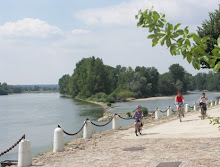
We are in the Loire Valley, so of course, the Loire river is a dominant feature. It's the longest river in France (1012km) rising in the Massif Central and reaching the Atlantic ocean at St Nazaire, near Nantes. When it passes through our area, it is wide and regal - flowing deepest in late spring, with the snow melt run-off from the upstream mountains - and even when the river levels are low in summer, revealing islands and sand banks, it is still deemed too dangerous for swimming.
There are other rivers to see too, though; the most notable are the Vienne, Indre and Cher - all tributaries of the Loire, and all with their unique charms and character. The Vienne runs through Chinon; it's gentler-flowing and ideal for the canoe trips you can take from there. The Indre passes near Chateau Ussé (the 'Sleeping Beauty' chateau) and looks like a moat as it flows round the chateau in Azay-le-Rideau. The chateau of Chenonceau - the most visited in the Valley - straddles the river Cher; there are great reflection photos to be had if the light is right.
Monday, October 31, 2016
Bourgueil town
Our breaks are based in and around the market town of Bourgueil. With a population of around 4000 this small town has narrow streets, beautiful stone buildings and plenty of cafés to relax in. It is also where you'll find the local restaurants and supermarkets. For such a small town, we are blessed with a great range of places to eat, from an excellent pizza and galette restaurant (save room for a crepe dessert) the wine bar/brasserie where you visit the cellar to choose your own wine, and a couple of high quality gourmet restaurants which won't break the bank. There are also 3 supermarkets if you prefer to cater for yourselves one -or more nights; maybe you'll concoct a 4 course feast, enjoy a barbecue, or grab some local cheese and wine and a crusty baguette and enjoy them in the garden of your accommodation.
Our breaks all include transport to and from Bourgueil for the restaurants and supermarkets, so you can enjoy the full range of what's on offer. We also include a visit to the weekly market; the whole centre of town is pedestrianised and you can browse around 80 stalls - mostly food, but also clothes, hats, bags, shoes, kitchen tools....Why not pick up provisions for a picnic lunch, then enjoy a coffee at a pavement café and watch the world go by.
Thursday, April 4, 2013
Chateau de Gizuex
One of the closest chateaux to us is in the village of Gizeux. It doesn't feature heavily in the guide books and is certainly not on the itineraries of the whistle stop tour buses that visit the Loire. It is, though - in my opinion - well worth a visit, for several reasons.
The chateau is owned by Géraud and Stéphanie de Laffon and has been in their family since 1786. They live there with their 6 children and the on-going restoration of their (very large!) family home is a life-long passion.
Visits to the chateau are guided - often by the owners themselves - and this gives you a fascinating insight not only to the very personal history of the building and its inhabitants, but also what it means to be the owners and - as they call themselves - safe-keepers of this heritage. If you are lucky enough to join the summer visit at 10.30am, in addition to the usual tour, you will get to visit the private salon and the attics and learn in even more detail what is involved in the upkeep and restoration.
One personal story which sticks in my mind relates to the chateau's cellar. Here there is an underground tunnel which leads to the presbytery next to the church in the village centre. During the war, French resistance members were hidden here, despite part of the chateau being used by German soldiers. A few years ago, Géraud was conducting a visit and whilst in the cellars, an elderly gentleman gave him the first names of 4 people and asked if they still lived there or locally. Géraud answered 'yes, they are my mother and her brother and sisters, my mother still lives here - do you know her well?' The gentleman said he didn't know her at all; whilst he was hiding in the cellars during the war (he was a resistance member), he heard those names being called each day at mealtimes, and had remembered them all that time.
The 'jewel in the crown' of the visit is the gallery of chateaux - 400 square metres of art painted directly onto the walls by art students in 1680; you can see the progression of their skill as you move from the first painting to the last. Currently undergoing skilled restoration, these almost 400 year-old tableaux are truly remarkable.
There is plenty to interest all ages, in English as well as French - as well as the chateau visit, there is a treasure hunt in the gardens, special events in summer for children (bread baking, costumes for the children to wear and coat-of-arms workshops) and even a wine-tasting visit at 11.15.
The chateau is open every day from Easter and we have details of visit times and special workshops. It is on a pretty cycling circuit (38km) through the forest and you can either take a picnic to enjoy in the chateau grounds or have a simple lunch in the orangerie.
Visits to the chateau are guided - often by the owners themselves - and this gives you a fascinating insight not only to the very personal history of the building and its inhabitants, but also what it means to be the owners and - as they call themselves - safe-keepers of this heritage. If you are lucky enough to join the summer visit at 10.30am, in addition to the usual tour, you will get to visit the private salon and the attics and learn in even more detail what is involved in the upkeep and restoration.
One personal story which sticks in my mind relates to the chateau's cellar. Here there is an underground tunnel which leads to the presbytery next to the church in the village centre. During the war, French resistance members were hidden here, despite part of the chateau being used by German soldiers. A few years ago, Géraud was conducting a visit and whilst in the cellars, an elderly gentleman gave him the first names of 4 people and asked if they still lived there or locally. Géraud answered 'yes, they are my mother and her brother and sisters, my mother still lives here - do you know her well?' The gentleman said he didn't know her at all; whilst he was hiding in the cellars during the war (he was a resistance member), he heard those names being called each day at mealtimes, and had remembered them all that time.
The 'jewel in the crown' of the visit is the gallery of chateaux - 400 square metres of art painted directly onto the walls by art students in 1680; you can see the progression of their skill as you move from the first painting to the last. Currently undergoing skilled restoration, these almost 400 year-old tableaux are truly remarkable.
There is plenty to interest all ages, in English as well as French - as well as the chateau visit, there is a treasure hunt in the gardens, special events in summer for children (bread baking, costumes for the children to wear and coat-of-arms workshops) and even a wine-tasting visit at 11.15.
The chateau is open every day from Easter and we have details of visit times and special workshops. It is on a pretty cycling circuit (38km) through the forest and you can either take a picnic to enjoy in the chateau grounds or have a simple lunch in the orangerie.
Sunday, March 17, 2013
Schools in France
We often get asked by our guests what education is like in
France, and how it is different from where they live. Now that between them our boys have
experienced all levels of French education from ‘petit section’ (first year of
nursery school) through to university, I thought I would describe the system of
state school here. This is very much our
personal experience and I understand that school hours/systems may be slightly different
throughout France, but hopefully this will give you an idea.
Compulsory education in France begins at age 6. However, all children from age 3 are
guaranteed a free nursery school place and so most children start earlier than
6, albeit maybe on a part-time basis.
The 3 years of nursery school are called petit, moyen and grand sections
and emphasis is on learning through play.
School hours are from 9.00am to 4.30pm four days a week, with an hour
and a half break for lunch (at this age, certainly here in a rural area, most
children go home for lunch). In petit
section, Max and his classmates all went to a little dormitory after lunch for
a sleep.
Primary school runs for 5 years, to age 11. The hours are the same and still 4 days a
week; here our boys had Wednesdays off.
Starting from 2013 or 2014, this is being changed to 4 1/2 days, to
include Wednesday mornings. Emphasis at
primary age is on learning the basics - lots of French grammar and conjugation
- plus the introduction of science, history/geography (one subject), art,
music, English, computer studies and sport.
At our boys’ school desks are arranged in rows facing the blackboard and
work is in the main done individually with little talking (too much and you are
moved to a desk by the teacher - we know this from experience...!). The children are tested often, at the end of each 'module' and in all
subjects (including sport).
Collège (senior school) comes next; 4 years of study with
everyone following the same syllabus and subjects. School hours are now 8.30am to 5.00pm four
days a week, plus 8.30 to 12.30 on Wednesdays, all still with a 90 minute lunch
break. At our boys' college there were
also lots of lunchtime clubs - Adam was involved in a cinema club which
produced a film at the end of the year, and Max's rugby team recently came 2nd
in the regional competition. Constant
testing continues through collège, culminating in the Brevet exam - French,
Maths, History/Geography, plus an English oral exam and computer skills
testing.
After collège, students have a choice – the main options
being academic or vocational Baccalaureats, or other vocational qualifications
intended to lead to a specific career or work.
We only have experience of the academic Bac – which for Adam (having chosen
the science stream) involved studying French, maths, physics/chemistry,
biology, history/geography, English, German, sport and , in the final year,
philosophy. Study was for 3 years,
school hours 8.00am to 6.00pm four days a week and 8.00am to 1.00pm
Wednesdays. Still the same constant
testing and a final exam in all subjects – to pass you have to gain an average
over all subjects of at least 10/20.
Whilst the vocational study route often leads to a job (or
job hunt these days) at the end - although students can of course opt for
further studies – an academic Bac is seen as a stepping stone to further
studies only, usually a minimum of 3 years.
Again there is a choice of route – for those students with a clear idea
of their future career this is often at a specific ‘school’ (engineering,
medical, business, law); otherwise the route is university. For this latter the entry requirement is a
pass at Bac; for the other options there is usually a more selective process
which can include Lycée (high school) results, an entrance exam and/or an
interview. Interestingly, for medical
school only a Bac pass is needed; halfway through the first year there is an exam
process and failure at this means you leave medical school immediately.
Most students at this level choose a school or university
close to home and many travel daily to their studies whilst living at
home. On site campus accommodation is
rare so students wishing to live away from home usually have a privately rented
apartment (studio/bed-sit/cupboard with a bed and toilet!!).
After a 3 year ‘licence’ (degree) students can enter a job
at certain prescribed levels; further study (masters or the equivalent) opens
opportunities at a higher level (and the chance to progress further). This prescribed system of linking
qualifications so closely with career progression - as opposed to experience or aptitude - means
that many years of study ‘post-Bac’ are common; jobs are usually advertised
with qualifications stated as Bac+ a number – representing the number of years
study beyond the age of 18 – and Bac+5 or more is pretty common. So the fact that state university is (for the
moment) free tuition-wise is a big bonus for those of us just setting off on
this stage of our childrens’ education!
Whether the French system is better, worse or just different
from the UK is impossible to quantify; Adam was 8 when we moved here so really
we have only experienced the French system.
They do of course have the benefit of being bilingual and, to some
extent, of experiencing both cultures. How
much of a benefit that is to them in adult life, only time will tell…but its
all part of the adventure.

Sunday, February 10, 2013
Going Underground
This part of the Loire Valley has a rich heritage of troglodyte buildings. Troglodyte means 'cave dweller' and probably the most well- known reason for the many caves, dwellings and now semi-troglodyte houses here, is that when the chateaux and manor houses were built for the kings and noblemen, the stone was quarried locally. This left holes (caves) in which the peasants then lived.
But there is an even older history of underground living here and one of the most impressive places to see this is the Chateau de Brezé. A short distance from Saumur, whilst the visible chateau was built in the 1300's, the earliest record of a 'chateau' here dates back to 1063. But to see where the noblemen of this time lived, you have to go down...up to 20 metres below the current ground level.
Back in the 'dark days' the land was often invaded and so those with enough money, power and peasants (to do the work!) dug out a fortified underground home for their family. Adults, children, and even livestock used to live underground at times of peril and leave those less fortunate to the mercy of the marauding hordes. You can see niches carved into the stone for chicken roosts, holes used to tie up cattle and horses, and great carved out columns for chimneys and air holes.
This underground village was also tremendously well fortified - with portcullis, narrow winding passages (impossible for attackers to carry spears) and false entrances.
In the 14th century the above-ground chateau was fortified and the dry moat constructed. In places this is 20 metres deep and is the deepest in Europe and really very impressive; you can see how impenterable the chateau was.
Impressive though the moat itself is, there are more surprises hidden in its inner walls. During your visit you can see grain stores, silkworm caves, stables and a wonderful 2 storey boulangerie - complete with what must have been a very cosy baker's bed right above the bread oven! The chateau also owns vineyards and you can see the extensive wine caves (and old stone wine presses) before tasting the produce in the (above ground) stable buildings in the grounds.
But there is an even older history of underground living here and one of the most impressive places to see this is the Chateau de Brezé. A short distance from Saumur, whilst the visible chateau was built in the 1300's, the earliest record of a 'chateau' here dates back to 1063. But to see where the noblemen of this time lived, you have to go down...up to 20 metres below the current ground level.
Back in the 'dark days' the land was often invaded and so those with enough money, power and peasants (to do the work!) dug out a fortified underground home for their family. Adults, children, and even livestock used to live underground at times of peril and leave those less fortunate to the mercy of the marauding hordes. You can see niches carved into the stone for chicken roosts, holes used to tie up cattle and horses, and great carved out columns for chimneys and air holes.
This underground village was also tremendously well fortified - with portcullis, narrow winding passages (impossible for attackers to carry spears) and false entrances.
In the 14th century the above-ground chateau was fortified and the dry moat constructed. In places this is 20 metres deep and is the deepest in Europe and really very impressive; you can see how impenterable the chateau was.
Impressive though the moat itself is, there are more surprises hidden in its inner walls. During your visit you can see grain stores, silkworm caves, stables and a wonderful 2 storey boulangerie - complete with what must have been a very cosy baker's bed right above the bread oven! The chateau also owns vineyards and you can see the extensive wine caves (and old stone wine presses) before tasting the produce in the (above ground) stable buildings in the grounds.
A visit to this unique chateau is included on our Discovery and Wine tours and we are working on a cycle route there too.
Tuesday, January 29, 2013
Bonne Année!
Every January, in common with other towns and villages all over France, the Maire of St Nicolas de Bourgueil and his fellow councillors hold a 'Ceremonie de Voeux' (New Year's wishes) for the village. The exact format differs from commune to commune, but each includes a word from the Maire reporting on completed projects from the previous year, plans for the current year and ends in wishing everyone in the village health and happiness for themselves and their families.
Our Ceremonie was held last Saturday and about a quarter of the population (350 folk) attended. After the word from Christel, our Maire, there was the prize giving for the best floral displays in the village in 2012 - 3 of the councillors travel all over the village during the summer and decide the worthy winners in the courtyard, roadside display and wine press categories (well, we are a wine-growing village!).
In St Nicolas, we also watch a film each year. A club in the village usually films all the year's events (school fete, annual football competition, new mother and baby ceremony on Mother's Day, etc.) and presents the film at the Voeux. This year though we were treated to the second part of a special three-film series which has documented the memories of the old folks in the village. As well as being a fascinating insight into the village's history over the past 80 years or so, this is an important record - St Nicolas was occupied during the second world war and much of the written records were destroyed - the number of villagers left who remember those days is sadly declining ( 3 have passed away since making this year's film) and so their memories are precious.
This year's film theme was traditional trades and schooldays of old. Villagers' filmed memories were interspersed with contemporary photos and documents as well as a couple of filmed demonstrations - one by an old basket-weaver and the other by a couple of real characters who used to be blacksmiths. Their description of the need to clean a horse's hooves before re-shoeing them taught the audience the saying 'le marechal ferrant touche le merde avant l'argent' (you'll have to look up the translation yourselves!).
For the schooldays section, the club had taken a group of current village children to a school museum to spend a day in traditional uniform learning about a typical school day and this footage was interspersed with the old folks' memories. This combining of young and old in the film was particularly touching.
As is tradition for almost every civic gathering here, the event ended with the 'pot d'amitie' - on this occasion sparkling wine and a slice of Galette des Rois (twelfth night cake) a puff pastry tart filled with frangipan - whilst villagers mingled to wish each other happy new year, complain about the terrible weather, gossip, chat and generally have a good time.
Our Ceremonie was held last Saturday and about a quarter of the population (350 folk) attended. After the word from Christel, our Maire, there was the prize giving for the best floral displays in the village in 2012 - 3 of the councillors travel all over the village during the summer and decide the worthy winners in the courtyard, roadside display and wine press categories (well, we are a wine-growing village!).
In St Nicolas, we also watch a film each year. A club in the village usually films all the year's events (school fete, annual football competition, new mother and baby ceremony on Mother's Day, etc.) and presents the film at the Voeux. This year though we were treated to the second part of a special three-film series which has documented the memories of the old folks in the village. As well as being a fascinating insight into the village's history over the past 80 years or so, this is an important record - St Nicolas was occupied during the second world war and much of the written records were destroyed - the number of villagers left who remember those days is sadly declining ( 3 have passed away since making this year's film) and so their memories are precious.
This year's film theme was traditional trades and schooldays of old. Villagers' filmed memories were interspersed with contemporary photos and documents as well as a couple of filmed demonstrations - one by an old basket-weaver and the other by a couple of real characters who used to be blacksmiths. Their description of the need to clean a horse's hooves before re-shoeing them taught the audience the saying 'le marechal ferrant touche le merde avant l'argent' (you'll have to look up the translation yourselves!).
For the schooldays section, the club had taken a group of current village children to a school museum to spend a day in traditional uniform learning about a typical school day and this footage was interspersed with the old folks' memories. This combining of young and old in the film was particularly touching.
As is tradition for almost every civic gathering here, the event ended with the 'pot d'amitie' - on this occasion sparkling wine and a slice of Galette des Rois (twelfth night cake) a puff pastry tart filled with frangipan - whilst villagers mingled to wish each other happy new year, complain about the terrible weather, gossip, chat and generally have a good time.
Bonne Année à Tous et à Toutes!
Subscribe to:
Posts (Atom)